Virginia doesn’t require home sprinklers. Ours get installed anyway, for reasons that hold up.
Most companies bury that first fact. We lead with it, because every residential sprinkler system in Northern Virginia is there to solve a real problem: a lot that can’t meet fire access rules, a well build that needs stored water, or a townhome with a system in the ceiling and nobody taking care of it. Published pricing, written quotes, crews licensed for Virginia work.
Three problems, one trade
Sprinklers instead of a second access road or hydrant
When a pipestem lot, a long wooded drive, or a missing hydrant fails fire access review, the fire marshal can accept a sprinklered house instead. Routinely the cheapest way through.
Read the straight versionWell water systems with tank and pump
Great Falls, Clifton, and the country west of Leesburg sit on wells. A stored water tank and a calculated pump make the system work, and we price both openly.
Read the straight versionInspection and repair for sprinklered townhomes
Arlington, Alexandria, Ashburn, and Woodbridge are full of units that came with sprinklers. We inspect with a written report, replace heads, and test backflows at house scale.
Read the straight versionFive parts, one job
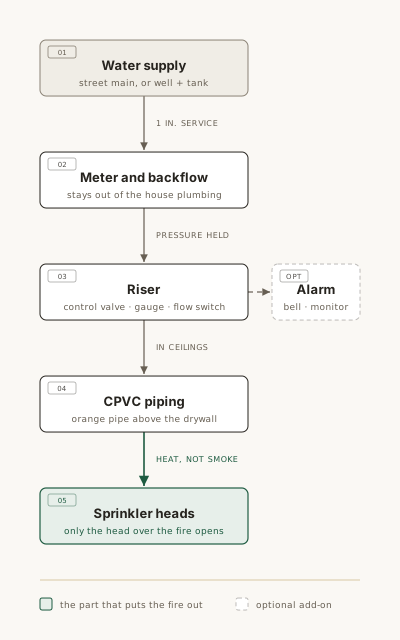
A home system is simpler than most people picture. Water comes in, sits under pressure in orange CPVC pipe above the drywall, and waits. Heat at the ceiling opens one head, that head sprays, and the flow switch at the riser can ring a bell or call the monitoring company. Smoke does nothing to a sprinkler head, and the other heads stay shut.
- 01Water supply. The street main feeds a 1 inch service. On a well, a stored tank and pump stand in for it.
- 02Meter and backflow. A backflow preventer keeps sprinkler water from drifting back into the house plumbing.
- 03Riser. Control valve, pressure gauge and flow switch, usually in the basement or garage. This is what gets inspected.
- 04CPVC piping. Orange pipe run above the drywall to every room, sized by the hydraulic calculation.
- 05Sprinkler heads. Each head opens on its own heat link. The one over the fire goes off. The rest stay shut.
Rough out your system in ten seconds
Three questions, priced straight off our published table. The real quote is written after we read your plans, and it is free.
Retrofit spreads wider than new construction because access and finishes drive the labor. The written quote pins it down.
Your lot failed fire access review. The fix is probably not a new road.
The fire code Virginia does enforce has opinions about getting an engine to your door: how long a driveway can run, where a private street can dead end, how far the nearest hydrant can be. Pipestem lots and long wooded drives fail those tests all the time. The code’s own relief valve is a sprinklered house, and hydrant spacing rules loosen substantially for one. Next to rebuilding a driveway to fire lane standards or extending a water main, the sprinkler system is routinely the cheap option. That conversation happens with the county fire marshal during site plan review, and it goes better with the hydraulic calculation already drawn.
Area guides
Each guide is specific: which neighborhoods sit on wells, where the townhome stock is, and how the local permit review runs. No two read alike because no two areas work alike.
Fairfax County
Fire sprinklers for Fairfax County lots that fail fire access review, well systems for Great Falls and Clifton, and inspections for sprinklered townhomes. Published pricing.
Great Falls · Clifton · McLean · Vienna
Loudoun County
Well and tank sprinkler systems for western Loudoun, fire access alternatives for long rural drives, and inspections for the Ashburn townhome stock. Published pricing.
Ashburn · Leesburg · Purcellville · Middleburg
Arlington and Alexandria
Inspection, repair, head replacement, and backflow testing for the sprinklered townhomes and stacked condos of Arlington and Alexandria. Written reports, published pricing.
Arlington · Alexandria · Ballston · Shirlington
Prince William County
Sprinkler inspections and repairs for the Woodbridge townhome belt, fire access alternatives and well systems for western Prince William County. Published pricing.
Woodbridge · Dale City · Gainesville · Haymarket
The numbers, before you call
Roughly $1.35 to $1.60 per sprinklered square foot in new construction, $2 to $7 for retrofit work depending on access and finishes, and typically $3,000 to $6,000 for the tank and pump on a well property. The cost page carries the whole table so you can check any bid against it, ours included.
See the cost guideWhat we will not do
- Tell you Virginia requires sprinklers in your new house. It doesn’t.
- Quote a well build without pricing the tank and pump out loud.
- Sell an install where an inspection and two new heads would do.
- Leave the permit filing to you. County filings ride in the quote.
Send the address, we read the plans
The sprinkler answer is cheapest before the site plan is final, and a leaking head is cheapest today. Either way it starts with the address.
Common questions
Does Virginia require sprinklers in new single family homes?
Not statewide. The Virginia building code leaves them optional for detached houses, but many new subdivisions, homes on long private drives, and lots without hydrant coverage get a sprinkler condition from the county fire marshal. Fairfax, Loudoun, and Prince William each apply it a little differently.
What is a 13D system and how is it different from a commercial one?
NFPA 13D is the residential standard. It uses fewer heads, smaller pipe, and can often run off the domestic water line without a separate meter. It is designed to hold a fire in the room it started in long enough to get out, not to protect the whole building the way a commercial system does.
How often does a home sprinkler system need inspection in Northern Virginia?
Once a year for a single family home. The visit covers the valve, the alarm test, pressure, and a visual check on every head. If your community association requires a report on file, we provide it.
Do fire sprinklers work during power outages?
On public water, yes, for the whole outage. The heads open from heat and the pressure comes from the street main. A house on a well or a stored tank depends on a booster pump, and that pump stops with the power unless it sits on a generator circuit. The full answer is in do fire sprinklers work during power outages.
Can a sprinkler system be added during a remodel?
Yes, and a remodel is the cheapest time to do it because the ceilings are already open. Whole house retrofits in a finished home cost more per square foot due to the access work. Our cost guide has current retrofit and new construction numbers.